How to Create a Professional Show Dossier for Festivals and Venues
Learn how to create a professional show dossier for festivals and venues, with a practical page-by-page structure and real examples from Avner, Leandre, and Les 7 Doigts.
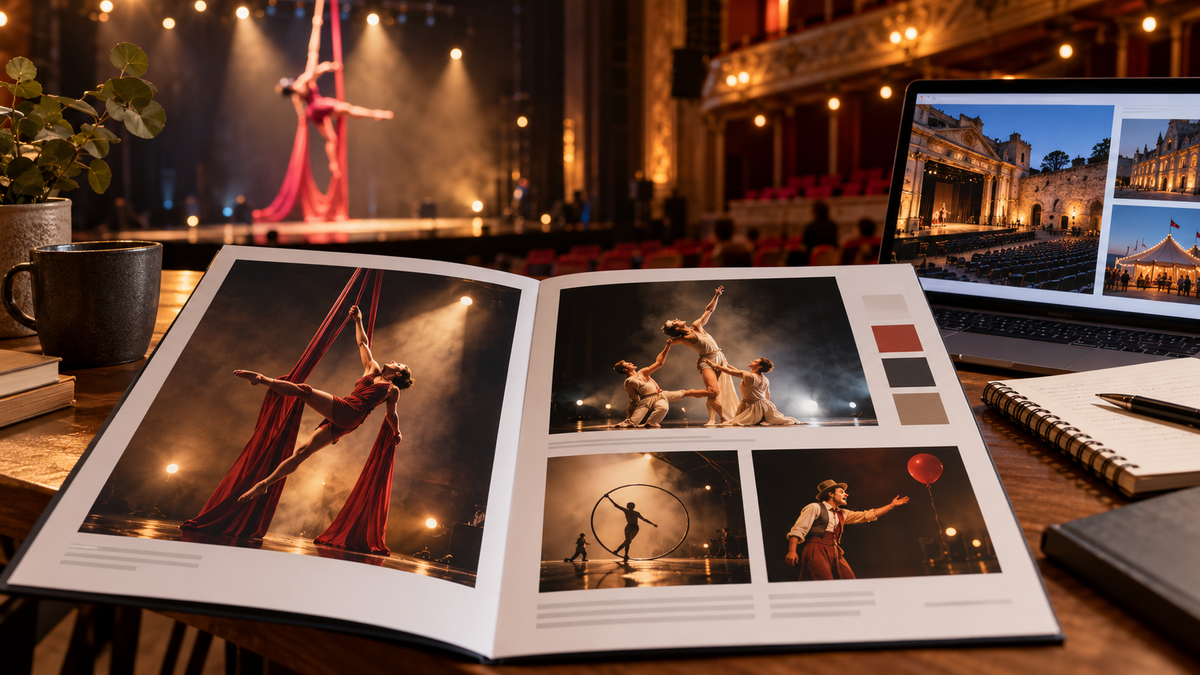
A professional show dossier has one job: help a festival programmer, theatre booker, or performing arts presenter decide whether your production belongs in their programme — and whether they can realistically host it.
For an independent circus artist, theatre company, clown, puppeteer, dance company, or street performer, this document can be one of the most useful tools for approaching new venues. It should communicate the artistic identity of your show while answering practical questions about audience, format, duration, touring requirements, and contact details.
A beautiful PDF is not enough. A dossier that is easy to evaluate is more valuable than a document filled with artistic language but missing essential information.
This guide explains how to build a show dossier for booking and touring, with a practical page-by-page structure and examples from established international performers and companies.
1. What Is a Show Dossier?
A show dossier is a concise presentation of one production, prepared for professionals who might programme, present, or book it. Depending on the country and sector, you may also hear artistic dossier, touring pack, programmer’s pack, or booking pack.
These labels are not completely interchangeable, but they share a purpose: making a show understandable to a potential presenter.
Unlike a press kit, which is primarily designed to support media coverage and publicity, a booking dossier must also communicate whether the performance is appropriate and feasible for a particular event or venue.
The Edinburgh Festival Fringe’s guidance on tour packs recommends including a synopsis, audience information, company background, technical requirements, relevant achievements, visuals, and booking contacts.
Think of the dossier as an introduction, not a replacement for a full-length show recording, detailed technical rider, contract, or individual booking conversation.
What should a programmer understand quickly?
A useful dossier lets its reader identify:
- What happens in the performance and what makes it distinctive.
- Who the show is for and where it can be performed.
- How long it lasts and how many people travel.
- What the main technical or spatial requirements are.
- Where to watch the show and how to contact the booking representative.
If answering these questions requires searching through several websites or long biographies, your dossier is making the programmer’s work harder.
2. Start with the Show, Not the Company
One common mistake is beginning with several pages about the artist’s career before describing the production being offered.
The first substantial page should explain the show itself. Introduce the company later, once the reader understands what they could actually book.
Write a clear, specific synopsis
You do not need to explain every scene or reveal every surprise. Describe the format, the central idea, and the experience that the audience can expect.
Too vague: “An innovative and unforgettable exploration of human connection that transcends boundaries and redefines the theatrical experience.”
More useful: “A 45-minute nonverbal physical-comedy performance for family audiences, combining live music, visual humour, and audience interaction. One performer transforms everyday objects into a sequence of increasingly absurd situations.”
The second example is fictional, but it helps a programmer immediately picture the show and identify possible audiences and venues.
Artistic language has an important place. It becomes most effective when accompanied by concrete information.
Make the show’s format immediately visible
Near the synopsis, include a compact facts section:
- Discipline: circus, theatre, dance, puppetry, physical comedy, or another relevant category.
- Duration: exact running time or a clearly identified approximate duration.
- Audience: adults, families, children, or a more specific audience; include minimum age when relevant.
- Language: spoken-language requirements, multilingual content, or nonverbal performance.
- Format: indoor stage, outdoor performance, street theatre, site-specific work, or adaptable setup.
- Company on tour: number of performers and accompanying technical or production staff.
- Availability: a relevant touring period if there is one; otherwise provide a direct booking contact.
Be honest about constraints. A show that requires a controlled, quiet theatre should not be advertised as suitable for every outdoor street festival.
3. Use Images and Video to Show the Actual Performance
Your dossier should help people visualise the production without requiring them to read several pages first.
Choose photographs from the show being offered, not generic portraits, rehearsal-room images, or unrelated performances. Strong images communicate the artistic language, staging, costumes, scale, and relationship with the audience.
Use one memorable image on the cover and a small selection inside the document. Avoid filling every page with similar photographs.
Include working links to:
- A short trailer that introduces the atmosphere and style.
- A full-length recording, if available and appropriate for professional viewing.
- A show page or gallery with additional photographs.
A trailer creates interest, but it may not show pacing, audience interaction, or how a complete piece develops. When programmers request a full recording, a short promotional edit is not an equivalent substitute.
If a recording is private, make sure the access link and password actually work. Test them in a private browsing window before sending the dossier.
A useful example: Les 7 Doigts
The official Duel Reality presentation by Les 7 Doigts demonstrates how a production can be introduced through a clear artistic premise, visual material, selected critical responses, and detailed creative credits.
This is a public show page, not a downloadable PDF dossier. Its lesson is about the hierarchy of information and how different kinds of evidence help a presenter understand a production. An independent artist does not need the scale or budget of Les 7 Doigts to apply the same principle.
4. Present Your Artistic Background Without Overloading the Reader
A programmer needs reasons to trust the people behind the work, but not necessarily a complete curriculum vitae.
Include a short artist or company biography that establishes:
- Your artistic discipline and approach.
- The creators or performers responsible for the show.
- Relevant experience with similar audiences or venues.
- A few meaningful festival appearances, awards, or professional collaborations.
Select achievements according to the production you are pitching. A family-oriented street arts festival may value experience performing outdoors more than an unrelated prestigious credit.
For a solo performer, a focused biography may take only a paragraph. For a larger company, introduce the company and identify the principal creative team without devoting a page to every contributor.
A useful example: Avner the Eccentric
Avner the Eccentric makes both short and full biographies available. His website also separates tour history, booking representatives, and technical documents.
This is a particularly useful model for an independent artist: the initial presentation can stay short while deeper professional information remains accessible.
It is also a reminder to keep production documents current. Avner’s technical page explicitly identifies the English rider as the version to use and warns that the other language versions have not been updated.
5. Explain the Touring Conditions Without Turning the Dossier into a Rider
A compelling artistic concept may still be impossible to programme if a venue cannot provide the required space, equipment, or technical support.
Your dossier should therefore contain a technical summary, followed by a link to a separate, up-to-date full rider when needed.
Useful information includes:
- Minimum performance area and ceiling height.
- Indoor or outdoor suitability and whether the surface must be level.
- Essential sound, lighting, power, or rigging needs.
- Setup, rehearsal, and dismantling times.
- Number of people travelling.
- Important accessibility, safety, or audience-management conditions.
- What the company brings and what the presenter must provide.
Distinguish your minimum requirements from your ideal configuration. If the show can genuinely be adapted for smaller venues, state the available alternatives clearly. Do not describe adaptations that have never been tested.
A full technical rider may need stage plans, input lists, lighting plots, rigging specifications, and other operational details. Those documents can be shared separately with production staff.
A useful example: Leandre Clown
Leandre’s N’imPORTE quoi official dossier is an 11-page PDF that combines an evocative synopsis, creative-team information, artist biographies, practical production details, and a booking contact.
Its practical section identifies a running time of approximately 70 minutes, six people on tour, ideal and minimum performance-space dimensions, and setup and dismantling times.
The lesson is not that every dossier must be 11 pages long. It is that artistic identity and concrete touring facts can coexist in the same document.
Documents and contacts, always at hand.
Keep contracts, riders, travel details and contacts organized by date, and share them with the people who need them.
6. Give Evidence, but Keep It Relevant
A dossier may include selected festivals where the show has appeared, professional reviews, awards, recommendations, or touring experience.
These details help establish context, but only when they are accurate and relevant.
Consider including:
- A short list of recognisable previous venues or festivals.
- One or two concise, attributed review excerpts.
- An award clearly connected to the artist or production.
- A notable international tour or presenting partnership.
Avoid long, unfiltered lists that are difficult to scan. Do not suggest that a company-level award was won by the particular production unless that is true.
If your show is new, you do not need to invent a track record. You can present previous work by the creators, a confirmed premiere, a development residency, or honest work-in-progress material — with each clearly labelled.
The goal is credibility, not the appearance of a bigger career than you have.
7. Finish with a Clear Booking Path
A programmer who wants to know more should not have to investigate who represents your show.
Give the name of the responsible person, their role, a working email address, and an appropriate website or professional contact channel.
If representation differs by region, make that clear. Avner’s booking page, for example, lists different contacts for different territories.
You may also mention relevant upcoming touring regions or dates, educational workshops, post-show discussions, or alternative versions of the performance — but only if they are genuinely available.
Should the dossier include an artistic fee?
For a general-purpose dossier, it is often more practical to negotiate fees separately. The total offer may depend on travel, the number of performances, technical provisions, workshops, and local arrangements.
The Edinburgh Festival Fringe’s touring guidance likewise recommends keeping detailed budgets and fee negotiations outside the publicly shared promoter pack.
If a festival explicitly asks for a fee, quote, or budget in its application, follow those instructions. A dossier should support negotiation, not conceal information a specific application requires.
8. A Practical Six-Page Show Dossier Structure
There is no universal page-count requirement. For many independent productions, four to six well-organised pages can be a useful starting point. More complex shows may legitimately need more space.
Here is one possible six-page structure:
Page 1 — Cover
Show title, a strong performance photograph, artist or company name, discipline, and a website or booking contact.
Page 2 — The show
A concise artistic synopsis, the main audience experience, and the key facts: duration, audience, language, and performance format.
Page 3 — Visual proof
Two or three purposeful photographs, a clickable trailer, and a full-show video link where available.
Page 4 — Artists and credibility
Short company biography, key creative credits, and a selective list of significant appearances, awards, or reviews.
Page 5 — Touring essentials
Minimum performance space, technical overview, setup times, people on tour, and a link to the full technical rider. Include adaptation options only when confirmed.
Page 6 — Contact and availability
Booking representative, touring availability or region, and links to the main show page and supporting documents.
This is a framework, not a mandatory format. A solo street artist may communicate everything effectively in four pages; a multi-person contemporary circus production may need a longer document.
9. Make the File Easy to Receive, Open, and Use
Export the dossier as a PDF so its layout stays consistent across devices. Keep the text selectable, the links clickable, and the contrast and font sizes readable on a laptop or phone.
A few production checks make a difference:
- Use a descriptive filename, such as ShowTitle_Company_Dossier_EN.pdf.
- Compress photographs appropriately without making them look pixelated.
- Avoid unnecessary full-page graphics that make the file difficult to download.
- Use the show title consistently in the filename, cover, and email.
- Put the contact details in the PDF itself, not only in the accompanying email.
- Check the document language and update dates, availability, and personnel when they change.
- If you tour internationally, prepare additional language versions where useful and verify that their technical information matches the current version.
There is no single correct file-size limit. Follow the receiving organisation’s upload restrictions whenever they are specified; otherwise, optimise for quick sharing and comfortable reading.
It is usually better to send a link to a hosted PDF or show page than a folder of unrelated attachments. If an application requires a particular upload, submit that exact format.
10. Common Dossier Mistakes to Avoid
Describing the company before explaining the show
Give the reader the information they need to assess the specific production first.
Writing only in abstract artistic language
Poetic descriptions can establish atmosphere, but they should not replace discipline, duration, audience, and format.
Using impressive images from a different production
The booking material should represent what the presenter can actually hire.
Sharing only a short trailer when a full video is requested
Different materials serve different purposes. Respect the requested format.
Omitting the minimum technical requirements
A stage or festival may love the concept but be unable to accommodate the production.
Listing every past performance
Choose credits that demonstrate credibility and artistic fit.
Including expired or contradictory information
An old rider, a former contact person, or a different running time can cause confusion later.
Making the reader search for the next step
Provide one clear booking contact and working links.
Professional Show Dossier Checklist
Before you send your dossier, verify the following:
- The title, company name, and artistic identity are unmistakable.
- The synopsis describes what audiences will actually experience.
- Discipline, duration, audience, language, and format are easy to find.
- Photographs show the correct production.
- Trailer and full-performance links work where applicable.
- The biography is concise, relevant, and accurate.
- Previous appearances, awards, and quotes are correctly attributed.
- The technical summary identifies real minimum requirements.
- The full rider is available separately if required.
- Touring personnel, availability, and booking contact are current.
- The PDF opens correctly on desktop and mobile.
- The dossier follows any specific submission instructions.
Final Thoughts: Make It Easy to Say Yes — or Ask the Right Questions
A successful show dossier is not necessarily the longest, most elaborate, or most expensive one. It is a document that communicates artistic identity and makes professional evaluation easier.
Established performers offer useful lessons in different forms: Leandre Clown demonstrates a complete show-specific dossier; Avner the Eccentric shows the value of separating concise introductions from detailed supporting information; and Les 7 Doigts illustrates how a production’s concept, visuals, reviews, and credits can work together.
Adapt those principles to your own scale, whether you travel alone with one suitcase or tour with a cast and technical team.
Once your dossier is ready, the next step is choosing the right opportunities and building relationships with programmers. Read our guide on how to apply to international performing arts festivals for the wider application process.
EyTour! helps independent artists and performing arts companies organise opportunities, manage booking conversations, and coordinate the work that follows a successful proposal.