How to Organise an International Artistic Tour: A Planning Guide for Artists and Companies
Learn how to organise an international artistic tour, anticipate festival open calls, manage several seasons at once and plan your bookings, routes and finances.
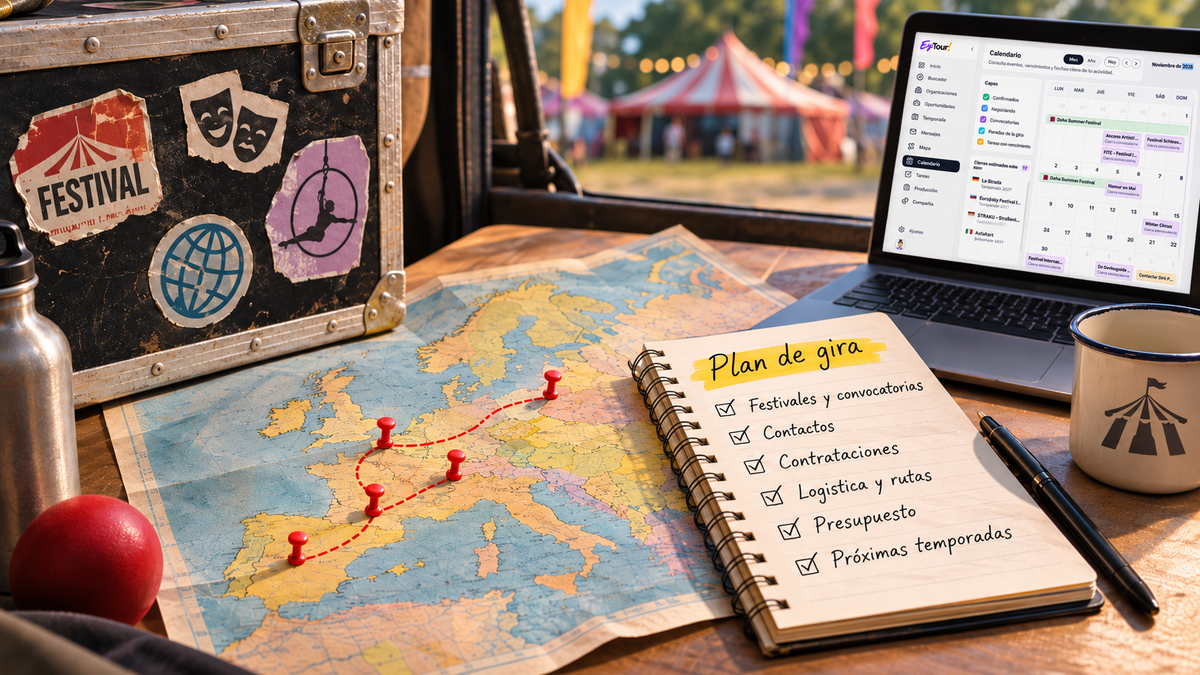
Going on an international tour is a goal for many performing arts professionals. Travelling with a show, discovering new audiences, taking part in festivals and building relationships with artists and organisations in different countries can make a major contribution to an artistic career.
Behind every tour, however, lies substantial work in research, communication, negotiation, production and logistical planning.
One of the most common mistakes is to think organising a tour is simply a matter of securing a few bookings and buying tickets. In reality, the work begins much earlier and continues even after you return home.
Touring internationally on a regular basis requires a system of working that generates opportunities continuously.
1. When should you start planning an artistic tour?
An international tour may begin to take shape one or two years before it takes place.
Gary Hills, an arts producer and manager, recommends in his Guide to International Touring, published by Caravan, allowing at least 18 months to prepare an international project.
In some cases, planning begins even before a show has been fully created.
The prospect of touring can influence artistic and technical decisions such as set design, company size, transport requirements and how the show can be adapted to different venues and cultural contexts.
Some festivals programme years in advance
Artistic programming calendars vary considerably from one festival to another.
For example:
- CPH STAGE (Denmark): plans an open call in spring 2027 for certain large-scale Danish productions that may be presented in its 2028 and 2029 editions.
- Awaji Art Circus (Japan): opened simultaneous calls for its 2026 and 2027 editions, with applications closing in March 2026.
- Pflasterspektakel (Austria): typically accepts applications between November and January for its festival in July.
These examples show that while some festivals accept proposals around six months before the event, others start their selection processes almost two years in advance.
Moreover, many organisers work through direct invitations and programming processes that do not necessarily involve public open calls.
So if you are thinking of starting a tour in six months, some of the most interesting opportunities may already have closed their selection processes.
2. Artistic planning as an ongoing process
Once artists begin touring regularly, seeking opportunities stops being an occasional activity and becomes part of their everyday work.
It is not a matter of organising a tour, completing it and starting from scratch the following year.
While travelling with your show, you may also be submitting applications for the next season, negotiating new bookings or researching festivals that will take place in two years' time.
Imagine an artist touring internationally for several consecutive years.
At any one time, they might be working on:
- 2027 season: performing and coordinating production for confirmed bookings.
- 2028 season: submitting applications, negotiating fees and building a new tour.
- 2029 season: researching festivals, making contacts and identifying early opportunities.
Each season is at a different stage of development, yet all form part of the same professional activity.
The Caravan guide recommends setting aside time every week specifically for a company's international development.
Making this part of your routine spreads the workload throughout the year, reduces the pressure to secure bookings in a short period and helps you seize opportunities that might otherwise go unnoticed.
3. How to manage several seasons simultaneously
One difficulty of international artistic touring is that opportunities do not arise in an orderly sequence.
In the same week, you might receive confirmation from a festival taking place in three months, discover an open call for the following year and make contact with a programmer interested in your show in two years' time.
To manage this information, distinguish potential opportunities from confirmed bookings and organise them by season.
An indicative planning timeline
24 to 18 months ahead:
- Research countries and regions.
- Identify festivals and artistic circuits.
- Develop professional contacts.
- Explore potential funding programmes.
18 to 12 months ahead:
- Make initial contact with programmers.
- Apply to early open calls.
- Prepare and update artistic materials.
- Identify possible touring periods.
12 to 6 months ahead:
- Send artistic proposals.
- Follow up.
- Negotiate financial terms.
- Identify the first confirmed bookings.
- Start building potential itineraries.
6 to 3 months ahead:
- Formalise contracts.
- Seek additional performances.
- Arrange transport and accommodation.
- Handle permits, visas and documentation.
During the final three months:
- Confirm technical details.
- Coordinate schedules and activities.
- Finalise logistical planning.
- Review the terms agreed with each organiser.
During and after the tour:
- Record financial results.
- Stay in touch with organisers.
- Create new audiovisual materials.
- Continue working on future seasons.
This timeline should not be treated as a rigid rule. Each project has its own schedule, and many of these activities can take place simultaneously.
What matters is having a system that helps you manage different time horizons without losing information or opportunities.
Plan the whole tour without losing the thread.
Put every date on the map, order your route, coordinate your team and keep your tour organized from start to finish.
4. Define your touring objectives
Before deciding which countries to travel to, ask yourself why you want to undertake an international tour.
Your objectives may vary considerably:
- Generate income from your show.
- Introduce a new production.
- Access new artistic markets.
- Take part in major festivals.
- Build relationships with agencies and programmers.
- Develop international collaborations.
- Explore new creative possibilities.
- Take part in artistic residencies.
- Broaden your professional experience.
A tour focused on generating income will not necessarily have the same characteristics as one intended to present a show to industry professionals.
You can also combine several objectives.
Defining them will help you decide which opportunities to prioritise, how much money you are prepared to invest and how to evaluate the results.
5. How to choose countries and regions for a tour
Although the possibilities for international touring are vast, trying to access every market at once can spread your efforts too thinly.
A more efficient strategy is to identify regions with opportunities that suit the characteristics of your show.
To do this, consider:
- The number of festivals specialising in your discipline.
- The times of year when they take place.
- Financial booking conditions.
- Ease of travel between cities and countries.
- Immigration requirements.
- The cultural characteristics of audiences.
- The show's language requirements.
- The cost of living.
- Professional contacts you already have in the region.
For example, a visual circus or physical theatre show may travel more easily between countries with different languages than a work that relies primarily on spoken text.
Similarly, a company of ten people with a large set will have different logistical needs from an artist who can fit their show into a suitcase.
Not every market is suitable for every production.
6. Research international festival circuits
Numerous networks, professional markets, festivals and organisations facilitate the circulation of shows.
Good research is not simply a matter of typing the name of an artistic discipline into a search engine. It also means understanding how each region's professional ecosystem works.
Directories and professional networks
Some useful resources to get started are:
- Circostrada, an international network for contemporary circus and street arts.
- CircostraData, a directory of festivals and artistic venues.
- IETM, an international contemporary performing arts network.
- IN SITU, a European platform dedicated to artistic creation in public spaces.
- On the Move, a network specialising in international cultural mobility.
- FestivalFinder, an arts festival directory.
Markets and professional gatherings
There are also events that bring together artists, companies, producers, distributors and programmers.
These include:
- FiraTàrrega, in Spain.
- CINARS, in Canada.
- Edinburgh Festival Fringe, in Scotland.
- Yokohama International Performing Arts Meeting (YPAM), in Japan.
- Performing Arts Market in Seoul (PAMS), in South Korea.
These gatherings can facilitate access to new markets and help build long-term professional relationships.
Research other artists' touring histories
One of the most useful strategies is to identify artists and companies with work similar to yours.
Look at their websites, social media, schedules and archives of past tours.
Which festivals have they taken part in? Which countries have they visited? Which organisations have programmed their shows?
This research can help you discover unfamiliar artistic circuits and opportunities that would be difficult to find through conventional searches.
7. Don't restrict your search to open calls
Finding an open call is an immediate opportunity, but discovering a festival whose call has already closed is valuable too.
If the event seems suitable for your show, record it.
Find out when it usually takes place, when it opens applications, who its programmers are and how it selects artists.
That way, you can prepare for its future editions.
Moreover, not all festivals use public application forms. Some receive proposals by email, others work through agencies, and others develop their programmes through recommendations and direct invitations.
It is therefore worth building an opportunity database that includes both events you can apply to now and those that may be relevant in the future.
Our guide on how to apply to international performing arts festivals explores the different ways of submitting an artistic proposal in more detail.
8. Build long-term professional relationships
Artistic bookings are not always the result of a single email or application.
In many cases, an opportunity arises after several exchanges, professional gatherings or recommendations.
The Iceland Performing Arts Centre's international touring handbook emphasises maintaining relationships with organisations and industry professionals, whether or not there is an immediate booking.
A programmer might discover your work this year, see it at another festival next year and invite you to take part in a later edition.
That is why it is important to keep a record of your professional relationships.
Record who each contact is, where you met them, which show you presented, when you last communicated and what possibilities for collaboration arose.
It is also advisable to keep your promotional materials up to date.
Having a good professional show dossier, videos and photographs makes it easier for programmers to share your proposal internally and consider it for future seasons.
A professional network takes time to build and can become one of your artistic practice's most valuable resources.
9. Build your tour around anchor dates
A technique used in music touring, which also applies to the performing arts, is to identify performances that serve as anchor points.
Known as anchor shows, these are bookings around which the rest of the itinerary is built.
They might be:
- A major festival.
- A financially attractive booking.
- An artistic residency.
- A series of performances at the same venue.
- A relevant professional gathering.
- A commitment to an organisation.
Imagine you have two confirmed festivals in Europe:
- Toulouse, France, on 7 July.
- Stuttgart, Germany, on 19 July.
Instead of looking for new bookings anywhere on the continent, you could focus your research on places close to those dates and the route connecting the two cities.
For example, you could look for opportunities in Barcelona before arriving in Toulouse, in Lyon in the intervening period or in Strasbourg before travelling to Stuttgart.
This strategy makes better use of travel, reduces costs and allows you to offer organisers specific dates.
It can also help you negotiate new bookings.
Telling a festival you would like to perform in Europe during the summer is not the same as explaining that you already have confirmed performances in the region during particular weeks.
10. How to optimise routes and travel
A tour is not simply a collection of confirmed performances.
It also needs to work as a geographically, financially and logistically coherent route.
When building an itinerary, consider:
- Distances between cities.
- Actual travel times.
- Available modes of transport.
- Fuel, ticket and luggage costs.
- Arrival and departure times.
- Availability of accommodation.
- Set-up and pack-down requirements.
- Rest days.
- Possible delays or cancellations.
The shortest route is not always the best.
In some cases, a longer journey may be justified by an important booking. In others, an apparently attractive performance can create excessive expenses or jeopardise a subsequent booking.
It is also worth considering different transport options.
Flying may reduce travel time but increase luggage and set transport costs. A van may provide more independence, although it may involve longer driving hours and additional expenses.
The aim is to find a balance that allows you to fulfil your artistic commitments without creating an unnecessary logistical burden.
11. Not every touring day needs a performance
When new booking opportunities arise, it can be tempting to fill every available day.
However, an overly intensive tour can affect artists' health, the quality of the show and their ability to respond to unexpected situations.
Days without performances also serve important purposes:
- Rest and physical recovery.
- Travel between cities.
- Washing and maintaining costumes.
- Repairing materials.
- Rehearsals.
- Administrative work.
- Communication with future organisers.
- Developing new professional relationships.
In 2026, Perform Europe published a guide drawing on the experiences of 42 international artistic circulation projects that explored alternatives to traditional touring models.
Its proposals include the possibility of touring at a slower pace when appropriate, while also considering environmental sustainability and working conditions.
Staying in the same region for several days can enable workshops, local collaborations, encounters with other artists or deeper connections with communities.
A good tour is not necessarily one with the most performances, but one that enables artistic work under sustainable conditions.
12. Calculate the profitability of the tour as a whole
When evaluating an individual booking, it is common to consider what the organiser offers and how much it will cost to perform the show.
However, when several bookings are part of the same tour, costs can be distributed differently.
A performance that would not justify an international journey on its own may be attractive if incorporated into an existing itinerary.
Imagine a tour with the following income:
- Festival A: €1,500.
- Festival B: €800.
- Festival C: €1,200.
- Festival D: €600.
- Estimated hat collections: €900.
Total estimated income: €5,000.
On the other hand, there will be various expenses:
- International transport: €900.
- Travel within the destination region: €450.
- Accommodation: €400.
- Meals: €250.
- Other expenses: €100.
Direct expenses: €2,100.
The estimated balance would be €2,900 before deducting the artist's own remuneration, other professional costs and taxes.
You should also assess how much of that income is guaranteed. If no hat contributions are received, the balance would fall to €2,000.
These figures are illustrative, but they show why it is worth analysing both the individual result of each booking and the overall result of the tour.
For more on these calculations, consult our guide on how to calculate your performance fee.
Don't forget cash flow
A tour can be profitable and still present financial difficulties while it is taking place.
Imagine having to pay for flights and accommodation several months before travelling, while festivals will pay your fees weeks after the performances have ended.
Even if the final financial result is positive, you will need enough money in advance to cover those costs.
It is therefore important to record expected payment dates, negotiate advances whenever possible and maintain a reserve for unexpected expenses.
13. Research funding programmes and mobility grants
An international tour may require considerable investment, especially when entering a new market for the first time.
Public bodies, foundations and international programmes support certain artistic mobility projects.
Some resources to explore are:
- IBERESCENA: a cooperation and support programme for Ibero-American performing arts.
- Culture Moves Europe: a European programme for individual mobility and artistic residencies.
- Perform Europe: an initiative aimed at developing more sustainable models of international circulation.
- EFFEA: a programme encouraging the international development of emerging artists through collaborations between festivals.
- On the Move: guides and resources on cultural mobility funding in different parts of the world.
Every programme has its own eligibility criteria. Some are aimed at individual artists, others at companies, festivals or cultural organisations.
Not all fund conventional tours, and sometimes a partner organisation must take part in the application.
It is also worth researching grants available in your country of residence, as well as those offered by cultural institutes, embassies and regional bodies.
Remember that funding calendars do not necessarily coincide with festival calendars.
If you only start looking for funding after confirming all your performances, some calls may already have closed.
14. Prepare documentation and logistics
International artistic mobility involves responsibilities beyond organising performances.
Depending on the countries, tour duration, nationality of the participants and booking arrangements, different administrative requirements may apply.
Visas and work permits
Being able to enter a country as a tourist does not necessarily mean you are authorised to undertake paid artistic work.
Find out what documentation you need to work legally in each destination and what responsibilities the organiser must assume.
Insurance
Depending on the show, you may need travel insurance, medical assistance, professional liability insurance or coverage for the materials and equipment you transport.
International taxation
International bookings may involve withholding taxes, invoicing obligations and other administrative procedures.
It is important to know whether the agreed fees are gross or net and who will bear the relevant taxes.
Transporting materials
If you travel with musical instruments, sets or professional equipment, research transport conditions and customs obligations.
In certain countries and for eligible goods, the ATA Carnet can simplify temporary import and export procedures.
Technical coordination
Before travelling, confirm that each performance space meets your show's requirements.
Share the technical rider sufficiently in advance and check available resources, venue dimensions, set-up times and the availability of technical staff.
On the Move's Mobility Information Points offer specialist information and guidance on many administrative aspects of international cultural mobility.
15. Learn to manage uncertainty
One particular feature of artistic planning is that many decisions must be made before all the information is available.
You may be negotiating with several festivals simultaneously without knowing which will ultimately confirm your participation.
Two organisations may also be interested in booking you on the same weekend, or you may need to decide whether to accept an offer before hearing back from another festival.
To manage these situations, it is important to distinguish between the statuses of each opportunity.
For example:
- Opportunity identified.
- Initial contact made.
- Application submitted.
- Awaiting a response.
- In negotiation.
- Confirmed.
- Declined.
- Postponed to another season.
You can also work with provisional itineraries and different touring scenarios.
What matters is not confusing a possibility with a confirmed booking.
Before incurring non-refundable expenses, make sure your agreements are sufficiently clear and that you understand each booking's cancellation terms.
Planning is not about eliminating all uncertainty, but about having the information needed to make better decisions as circumstances change.
16. Digital tools for managing artistic tours
During the early stages of an artistic career, a spreadsheet, calendar and email account may suffice to manage professional opportunities.
However, as the number of festivals, contacts, applications and seasons grows, information starts to become scattered across different tools.
You may end up with hundreds of emails, documents in different folders, dates in several calendars and spreadsheets that need constant updating.
The challenge is no longer just finding opportunities, but managing all those you have accumulated in an organised way.
Today there are digital tools specialising in professional performing arts management.
EyTour!, for example, is a platform designed for artists, companies, producers and agencies that brings different aspects of artistic activity together:
- Organise booking opportunities.
- Record festivals and their various editions.
- Manage professional contacts.
- Follow up on applications and communications.
- Organise several seasons simultaneously.
- Plan tours and travel.
- Coordinate production details.
- Centralise information and documentation related to bookings.
Whatever tool you choose, what matters is developing a system that lets you retain information, consult the history of your activity and maintain continuity across seasons.
The information you collect over the years is also part of an artist's or company's professional assets.
17. Evaluate your results after every tour
When a tour ends, a new stage of work begins.
Alongside reviewing financial results, it is important to evaluate other aspects of the experience.
You might ask yourself:
- Which festivals offered the best conditions?
- In which countries did the show work best?
- Which journeys could have been avoided?
- Which expenses were higher than expected?
- Which performance spaces were most suitable for the artistic proposal?
- Which professional relationships developed?
- Which organisers might book you again?
- What new opportunities arose during the tour?
- What would you change next season?
Also record the contacts you made, new festivals you discovered and any information that may be useful for future bookings.
Thanking organisers, sharing photos and videos of performances and staying in touch can help generate new collaborations.
Each tour provides information that can improve planning for the next ones.
Conclusion: building an artistic career on the move
Organising an international artistic tour involves much more than travelling from one place to another with a show.
It requires understanding professional circuits, developing long-term relationships, researching opportunities, managing financial resources and making decisions under uncertainty.
Some bookings arise just a few weeks in advance. Others require more than a year's work. Some festivals even accept applications for editions taking place two years later.
Artistic planning should therefore be understood as an ongoing process.
While on one tour, you can be preparing the next and starting to build opportunities for future seasons.
Over time, each contact, festival, experience and booking can contribute to a more stable and sustainable international artistic practice.
The goal is not simply to organise a tour, but to build a system of working that enables you to tour regularly.
Sources and recommended resources
- Caravan — Guide to International Touring, Gary Hills
- Edinburgh Festival Fringe — Preparing to Tour
- Iceland Performing Arts Centre — International Touring Handbook
- MusicNSW — Tour Plan and Itinerary Template
- Perform Europe — Reimagine International Touring
- CPH STAGE — Open Calls
- Awaji Art Circus — Open Call 2026 & 2027
- Pflasterspektakel — Information for Artists
- On the Move — Mobility Information Points
- International Chamber of Commerce — ATA Carnet