How to Write an Artistic Proposal Email for Festivals and Theatres
Learn how to present your show by email, contact programmers, personalise proposals and follow up professionally. Includes practical email templates.
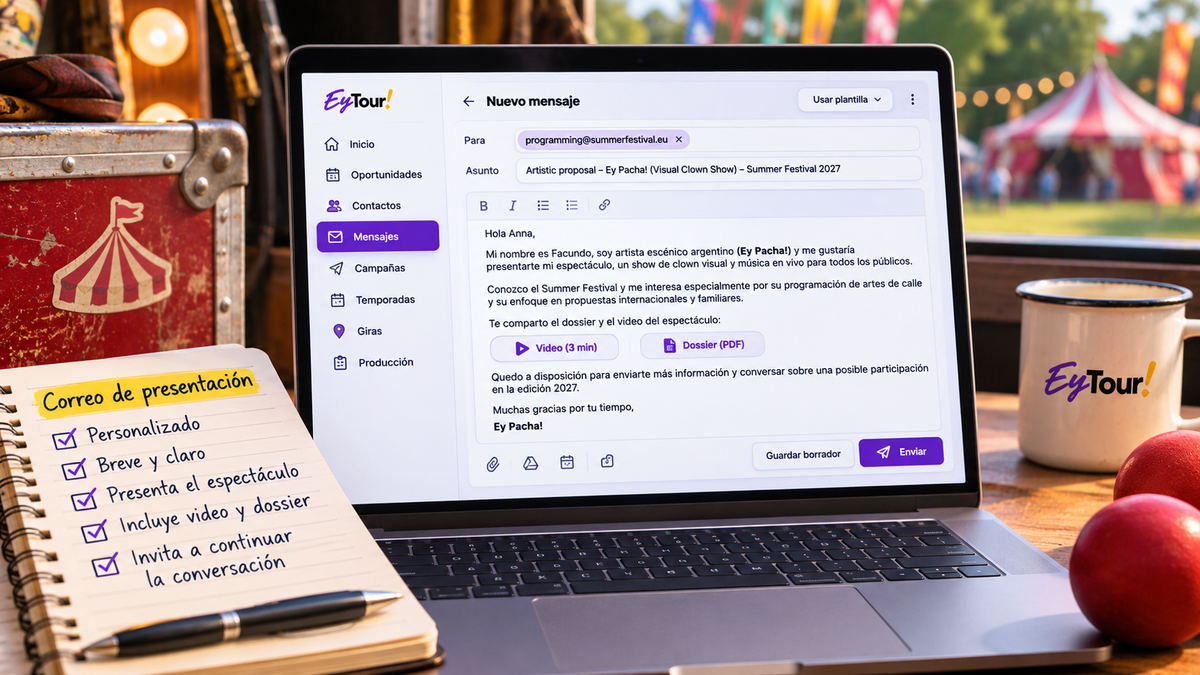
Sending an email to offer a show to a festival, theatre or cultural centre is a regular part of the work of many performing artists and companies. However, writing a good artistic proposal is not always easy.
How do you summarise a show in a few lines? What information does a programmer need to assess a proposal? When should you follow up if you have not received a response?
An introductory email does not need to explain your entire career or persuade an organiser to book you immediately. Its primary purpose is to spark interest, provide access to your work and open a conversation.
In this guide, we explore how to prepare a proposal, adapt it to each recipient and manage communications across different seasons, with examples you can use as a starting point.
1. Before writing: research who you are contacting
An artistic proposal begins long before you open your email.
For a show to have a chance of being included in a programme, there needs to be some compatibility between the artistic work, the context of the event and the organisation's objectives. A great show is not necessarily right for every festival.
Before contacting an organiser, take a few minutes to research:
- Which artistic disciplines and formats are included in their programme.
- Which artists and companies have participated in previous editions.
- What kind of audience usually attends.
- Whether performances take place in theatres, public spaces, tents or other venues.
- When the event takes place and when its programme is prepared.
- Whether the organisation accepts unsolicited proposals, works by invitation or uses public open calls.
This research will help you decide whether it is worth submitting a proposal and, if so, how to tailor your presentation.
Berlin's Performing Arts Program, in its guide On Tour! Tools, Tips and Strategies for Distribution Work, approaches distribution as an activity that combines identifying suitable venues with building professional relationships.
You can also research the artistic circuits in which artists with work similar to yours have participated. Our article on how to organise an international artistic tour offers more strategies for identifying markets and opportunities.
2. Find the right contact and communication channel
Not all festivals receive proposals in the same way.
Some publish an open call with an application form, others accept proposals by email, and others select shows through direct invitations. Even within the same organisation, procedures may vary depending on the artistic discipline.
Before getting in touch, check the programming, open calls, frequently asked questions and contact sections of the official website.
If several email addresses are available, look for the one associated with artistic programming, artistic direction or bookings. An address intended for press enquiries, ticket sales or customer service is usually not the most appropriate channel.
If you cannot identify the person responsible, you can write to the general email address and ask where you should direct your proposal.
For example:
Good morning,
I am a circus artist and would like to submit a show for your programme. Could you please let me know who the appropriate contact is, or whether you have a specific procedure for receiving artistic proposals?
Thank you very much for your help.
[Name]
If the festival requires all applications to be submitted through a form, respect that procedure. Sending an additional email with the same information will not necessarily improve your chances and may create duplicate work.
Our guide on how to apply to international performing arts festivals explains the different ways to apply and how to prepare the required materials.
3. Choose a clear and specific subject line
The subject line is the first information the recipient will see. It should help them understand what the message is about before opening it and find it again later if needed.
You can include the name of the show or company, the artistic discipline, the event you are contacting and the relevant season.
Examples in Spanish:
- Propuesta artística – [Nombre del espectáculo] – [Nombre del festival].
- Teatro de calle – Propuesta para la próxima edición.
- Circo contemporáneo – Disponibilidad para gira de verano.
- Invitación profesional – [Espectáculo] – [Ciudad y fecha].
Examples in English:
- Artistic proposal – [Show name] – [Festival name].
- Contemporary Circus – Touring Availability.
- Street Theatre – Festival Booking Proposal.
- Invitation to [Show name] – [City and date].
A subject line such as 'Hello', 'My show' or 'Important information' provides little context. There is no need to resort to exaggerated promotional claims or write in all capitals to attract attention.
When replying to an earlier message, stay in the same conversation thread as long as it concerns the same proposal. This allows the organiser to consult the previous correspondence without searching through separate emails.
4. How to structure an artistic proposal email
A good initial email can be relatively brief. As a practical guideline, aim for around 100 to 180 words, excluding the signature, although there is no ideal length that applies to every situation.
The key is to select the information the recipient needs to understand the proposal quickly.
Introduction and reason for getting in touch
Start with a greeting and a brief introduction. If you know the name of the person responsible for programming, use it naturally.
Explain who you are, which show you represent and why you are writing.
There is no need to begin with a lengthy biography, describe all your training or list every country you have worked in. That information can be available in your dossier or on your website.
Why you are contacting this organisation
One or two sentences may be enough to explain the connection between your proposal and the festival's programme.
For example, if its programme includes visual performances for family audiences, you could mention that your show uses physical comedy and can be enjoyed without understanding a particular language.
Personalisation should be based on real information. Do not claim to have attended a festival you have never visited or praise a show from its programme that you have not seen.
Show description
Describe what happens on stage, what characterises the work and what experience it offers the audience.
Rather than simply saying that a show is original, entertaining and unforgettable, try explaining what makes it distinctive.
For example:
A physical comedy and live music performance in which three characters turn everyday objects into instruments and create a collective musical score with the audience.
This description helps the reader imagine an artistic situation without relying on adjectives that could apply to almost any show.
Practical information
Include details that can help determine whether the work is suitable for the programme:
- Artistic discipline and performance format.
- Duration and intended audience.
- Number of performers on stage, where relevant.
- Whether it can be performed indoors or outdoors.
- Language requirements or whether the show is non-verbal.
- Availability, if you already have specific dates in mind.
There is no need to reproduce the entire technical rider. However, if the show requires an aerial rig, a large stage or particular blackout conditions, it is useful for the organiser to know this from the first contact.
Access to materials and closing
Share a link to the show video, dossier or website. Close by indicating that you are available to provide more information or discuss a potential booking.
A simple signature with your name, company, website and contact details may be sufficient.
5. Personalise your proposals without writing every email from scratch
When working with dozens of opportunities, writing each email entirely from scratch can take many hours.
A reusable template helps you maintain a consistent presentation of the show and avoid repeating the same work.
However, it is worth distinguishing between information that remains stable and information that should be adapted to each recipient.
Reusable information:
- Show name and description.
- Basic company details.
- Duration and available formats.
- Links to audiovisual materials and the dossier.
- Signature.
Information to personalise:
- The name of the organisation and the recipient.
- Why you consider the proposal relevant.
- The season or dates of interest.
- Characteristics of the venue or audience.
- References to previous conversations, where applicable.
For example, a dance company may present the same piece to a street arts festival and a theatre, but the two emails might highlight different aspects of the production, provided the show can genuinely be adapted to those contexts.
The Irish organisation Improvised Music Company offers a guide to email pitching from a musician's perspective. One idea that applies to other disciplines is to consider what distinguishes your project and how it relates to the work of the person receiving it.
It is also important to check personalised fields before sending. An incorrect name, an outdated date or a reference to another festival can undo the effort invested in preparing a relevant proposal.
6. What materials to send: videos, dossiers and links
An email does not need to replace your artistic presentation materials. Its purpose is to provide access to them.
A programmer may want to watch a video quickly, consult technical details later or share the proposal with other members of their team.
The show video
A short promotional video provides an initial impression of the visual style, performance dynamics and relationship with the audience. Whenever possible, prepare a longer or full-length recording for those who need to assess the dramaturgical continuity of the work.
You can use platforms such as Vimeo or YouTube. Check that the links work outside your own account and that access instructions are clear if a video requires a password.
If you use footage of audiences or other materials, ensure that you have the relevant permissions.
The artistic dossier
A dossier brings together information that does not need to appear in the email body: a fuller description, images, company members, artistic background, show characteristics and contact details.
You can send it as a PDF or share a direct link. If you attach it, keep the file size reasonable and use a recognisable filename, such as CompanyName_ShowName_Dossier.pdf.
Avoid filling your email with numerous documents that the organiser has not yet requested.
Our guide on how to create a professional show dossier offers recommendations for preparing this material.
The website and technical rider
A professional website can bring together videos, photographs, different language versions of the dossier and other reference materials.
A technical rider may be necessary from the outset if the festival requires it or if set-up conditions are decisive. In other situations, you can share it once the organisation expresses interest.
There is no universal rule about whether to attach documents or send links. Each organiser's instructions take priority over general recommendations.
Test access before sending and avoid relying on links that might expire before your proposal is assessed.
7. Which language should you write in?
When arranging international bookings, it will not always be possible to communicate in the recipient's language.
As a starting point, use the language indicated in the open call or contact instructions. If the organiser provides information in English and you do not speak their local language, English may be a reasonable option.
In other contexts, writing in the organisation's language can facilitate communication. Review translations carefully, especially proper names, dates and terms that describe the show.
There is no need to use excessively formal or complex expressions. A simple, accurate and easily understood message is usually more useful than an artificially sophisticated translation.
Adapt your materials too: an English-language dossier can be useful for international circuits, while a French, Spanish or other language version may be important in particular markets.
If someone replies in another language, try to continue in a language that is practical for both parties, without assuming that the recipient can hold a conversation in any language.
8. Example emails for presenting a show
The following templates are illustrative. Replace names, shows and circumstances with real information and check everything before sending.
Example 1. First contact with a festival
Subject: Artistic proposal – [Show name] – [Festival]
Hello [Name],
I am [Name] from [Company], and I would like to introduce our show [Title] for a future edition of [Festival].
It is a 40-minute contemporary circus and physical theatre performance for family audiences, adaptable to outdoor spaces. I have seen that your programme includes visual performances in public spaces, and I believe our work could be a good fit.
Here are our promotional materials:
Video: [Link]
Dossier: [Link]
I would be happy to provide further information or discuss a possible participation.
Thank you very much for your time.
Best regards,
[Name and signature]
Example 2. Presenting an international tour
Subject: [Show name] – European touring availability
Dear [Name],
My name is [Name] and I represent [Company], a contemporary circus company based in [Country].
We are planning a European tour between June and August and would like to introduce our show [Title] for your upcoming programme.
It is a 45-minute outdoor performance combining physical comedy and live music, suitable for audiences of all ages.
We already have confirmed performances in [City] and [City], and we are exploring additional opportunities in the region.
Show video: [Link]
Dossier: [Link]
I would be happy to discuss possible dates and share further information if the project is of interest.
Best regards,
[Name and signature]
This approach provides concrete information about the itinerary. Mention confirmed dates only if they are actually confirmed; otherwise, indicate that they are provisional.
Example 3. Inviting a programmer to see your show
Subject: Professional invitation – [Show name] – [City and date]
Hello [Name],
On [Date], we will be presenting [Show name] at [Event or venue] in [City].
Given the focus of your programme, we would like to invite you to see our work live.
The performance will take place at [Time] at [Venue]. If you are interested in attending, I can send you more details about access.
You can find a short video of the show here: [Link].
Best regards,
[Name]
In this type of email, the immediate purpose is not to secure a booking, but to give the recipient an opportunity to discover the work.
Brighton Festival itself explains how it develops its programme and highlights the importance it places on seeing work live and getting to know artists over time.
Example 4. Following up on a proposal
Subject: Re: Artistic proposal – [Show name]
Hello [Name],
I am writing to follow up on the email I sent a few weeks ago about [Show name].
I would like to know whether the proposal might be of interest for a future edition of [Festival].
I would be happy to share the video, technical rider or any additional information you may need.
Thank you and best regards,
[Name]
Example 5. Reconnecting for a new season
Subject: [Show name] – Upcoming touring season
Dear [Name],
I hope you are well. We were in touch last season about our show [Title].
We are currently planning our upcoming tour and I wanted to reconnect, as our work may be relevant to your next programme.
Since we last spoke, we have [brief relevant update].
Here is our updated material: [Link].
I would be happy to explore a possible collaboration if the timing is right.
Kind regards,
[Name]
Example 6. Responding to a rejected proposal
Subject: Re: [Show name]
Dear [Name],
Thank you for letting me know and for taking the time to consider our proposal.
I understand that the show will not be part of this edition.
If appropriate, I would be happy to stay in touch and share an updated proposal for a future season.
Wishing you a successful festival.
Best regards,
[Name]
A rejection does not necessarily mean the end of a professional relationship. At the same time, if the organisation indicates that it does not wish to receive future proposals, it is important to respect that.
9. When and how to follow up
Sending an email is only one stage of the process. Sometimes a proposal receives no response because the recipient is working on another edition, the selection process has not yet started or they need to consult other people.
In Catherine Launay's chapter of On Tour!, published by Berlin's Performing Arts Program, the author suggests considering a friendly reminder after approximately two or three weeks without a response. This is a starting point, not an obligation or a guarantee of success.
If the festival specifies when applicants will receive a response, wait until that period has passed. In a competitive open call, avoid putting pressure on the organisation while its selection committee is still working.
One possible timeline for direct proposals is:
- Day 0: first personalised email.
- Days 14 to 21: a brief follow-up if you have received no reply and the circumstances allow.
- Around day 35: consider a second contact, preferably if you have new or relevant information.
- Next season: reconsider the opportunity based on your communication history, the calendar and the organiser's preferences.
You can adjust these intervals if you are coordinating a tour with dates approaching or if the recipient asks you to get back in touch at a particular time.
A follow-up does not need to repeat the entire original message. It can simply remind the recipient of the proposal or provide a useful update: a newly confirmed performance, a recent video, an available date or an adaptation of the show.
If you receive no reply after several reasonable attempts, it is best to stop sending reminders and revisit the opportunity in the future only when there is a relevant reason.
The full Finder opens with early access.
Join the EyTour! waitlist to request early access and explore the full opportunities catalogue when your access is enabled.
10. What to do when an organiser replies
A festival's response can open up different possibilities. Not all of them require the same action.
If they express interest: answer their questions and provide the requested materials. Find out which dates, format and conditions are being considered.
If programming is already closed: when appropriate, ask when they prepare the next edition. Record this information so you do not have to start again without context next year.
If they refer your proposal to someone else: thank them for the guidance and use the indicated channel. Do not assume that the referral amounts to acceptance.
If they request a quote: check the number of performances, travel, accommodation, meals, technical requirements and payment terms before committing to a figure. Our article on how to price your show explains how to assess these factors.
If they reject the proposal: thank them for their time and record the response. If circumstances allow, another opportunity may arise in a future season.
Keeping a communication history lets each new exchange build on what has already been discussed, rather than treating the same organiser as an entirely new contact.
11. How to avoid your emails ending up in spam
It does not matter how much time you have spent writing a proposal if the message is never seen.
Email services use various mechanisms to identify unwanted communications. There is no formula that guarantees all your messages will reach the inbox, but some habits can help.
- Use a recognisable email address and maintain a consistent sender identity.
- Avoid sending large volumes of identical messages all at once.
- Contact only relevant organisations and use the appropriate channels.
- Use clear, honest subject lines and avoid excessive capital letters or exclamation marks.
- Share trustworthy links and avoid unnecessarily large attachments.
- Review your contact list and remove addresses that return delivery errors.
- Respect requests not to receive any more communications.
If you use an email address on your own domain, make sure it is properly configured for sending messages. If you are unsure, ask your email provider or whoever manages your website for help.
Gmail's official email sender guidelines provide further information, particularly for those who send communications in large volumes.
There is no universal number of emails you can send each day without risk. Follow your provider's limits and applicable privacy and commercial communication regulations. An address published online does not necessarily constitute permission to send advertising.
An artistic outreach campaign should focus on relevant recipients and respect their contact preferences, rather than becoming an indiscriminate mass mailing.
12. Automate administration without losing the personal touch
For an artist just starting out, an email inbox and a spreadsheet may be sufficient.
However, as contacts from different countries, pending conversations, requests for information and opportunities for several seasons accumulate, it is easy to forget a follow-up or send a proposal to someone you have already contacted.
Professional management tools can centralise these tasks. EyTour!, for example, is designed to organise the commercial and production activities of performing artists, companies and agencies.
Tasks that can be managed with these types of tools include:
- Record festivals, organisations and contacts.
- Keep a history of communications and applications.
- Prepare reusable templates containing show information.
- Schedule emails and organise campaigns targeting relevant groups of opportunities.
- Record reminders and pending follow-ups.
- Distinguish new opportunities, negotiations and confirmed bookings.
- Organise work by season.
Before any scheduled send, review the recipients, personalised information and whether the dates are still relevant. If you receive a response or a request not to receive further messages, update the relevant follow-up.
Automation can reduce repetitive tasks, but it does not replace the initial research or artistic judgement needed to decide whom to contact.
Automating administration does not mean indiscriminately automating professional relationships.
13. Common mistakes when presenting a show by email
Some mistakes can make a proposal difficult to assess even when the artistic work is of high quality:
- Writing to an organisation whose programme is unrelated to the show.
- Sending generic messages to every contact without checking the context.
- Getting the name, festival, season or recipient wrong.
- Attaching too many files or sending inaccessible links.
- Describing the show with praise without explaining what happens on stage.
- Omitting essential requirements such as the format, duration or space limitations.
- Repeatedly insisting after a rejection or a request not to be contacted.
- Treating an enquiry or provisional proposal as a confirmed booking.
Before sending, read the message from the perspective of someone who does not yet know your work. Can they understand what it is about? Do they know why you are writing? Can they access the materials and reply easily?
14. Analyse your communications and build long-term relationships
Artistic outreach does not end after sending a series of emails.
Recording which contacts responded, which organisations expressed interest and which requested further information can help you identify the circuits where your show is best received.
You can also observe whether certain materials generate recurring questions. If several programmers need clarification about duration or set-up conditions, it may be worth updating the dossier or show description.
Do not interpret every negative response as a judgement of your show's quality. Budgets, dates, available space, curatorial direction and selection criteria all influence programming decisions.
A professional relationship may begin with an unsuccessful proposal and lead to a collaboration years later. Keeping a record of contacts and their preferences will allow you to resume conversations when there is a genuine reason to do so.
Conclusion
A good artistic proposal email combines clarity, relevance and respect for the recipient's time.
Researching programmes, describing the show in concrete terms, sharing accessible materials and following up appropriately are tasks that can become part of the professional routine of a company or independent artist.
Email does not replace the experience of seeing a live performance or meeting in person. It is a tool for opening doors, maintaining conversations and helping your work reach those who may be interested in programming it.
It is not simply about sending more emails, but about building better professional relationships.
Sources and recommended resources
- Performing Arts Programm Berlin – On Tour! Tools, Tips and Strategies for Distribution Work.
- On the Move – On Tour! Tools, Tips and Strategies for Distribution Work.
- Improvised Music Company – Standing Out & Piquing Interest: Email Pitching.
- Improvised Music Company – Hit the Road, Jack: A Guide to Touring.
- Brighton Festival – How We Programme.
- Google – Email Sender Guidelines.